Residential electricity and gas demand in Great Britain: archetypal demand profiles and household explanatory factors
Abstract
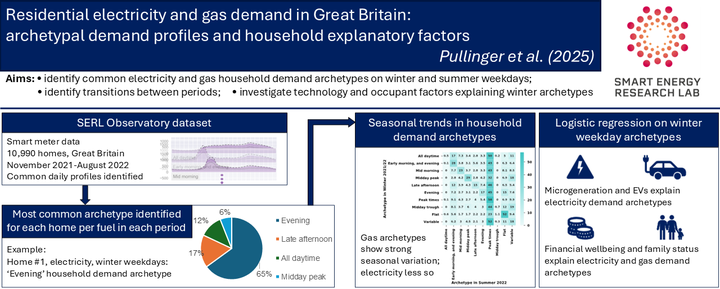
Understanding household energy demand patterns is essential for effective energy system planning and policy design. This study identifies household electricity and gas ‘demand archetypes’ which capture the typical summer and winter weekday demand profiles for each home. We apply logistic regression with household survey data to identify correlations with those archetypes. Our study uses half-hourly smart meter data from the Smart Energy Research Lab Observatory in Great Britain (April 2024–March 2025); over 10,300 households with electricity and 8200 with gas data after filtering. We develop a methodology for defining household demand archetypes that provides insights into the variability in demand profiles over time, generally obscured in previous research. While household gas demand archetypes vary substantially between seasons, consistent with varying heating needs, electricity archetypes exhibit highly variable demand profiles even within one season. Significant correlations are found between archetype and a range of dwelling and occupant factors. For example, strong correlations are found between microgeneration and a midday electricity demand trough on winter weekdays, but also with midday demand peaks, perhaps indicating overzealous attempts to utilise solar generation in the home. Households reporting low financial wellbeing are less likely to exhibit ‘all daytime’ and ‘morning and evening’ gas archetypes; perhaps indicating efforts to reduce costs. The unexpected relationships between demand patterns and low carbon technologies, as well as the high levels of variability in demand over time, highlight the complexity of predicting the impacts of technology-led efforts to decarbonise the energy system.